Florida-based OSHA compliance video intelligence
Active OSHA compliance from ordinary construction cameras.
OSHA Compliance AI converts passive site video into measurable safety evidence: object tracks, 3D spatial relations, rule-based OSHA findings, and audit-ready reports for management and compliance teams.
"You spend thousands of dollars on video surveillance systems that do not protect you from $160,000 OSHA fines. Why? Because no one watches this video."
OSHA Compliance AI is an independent compliance-support product and is not affiliated with, endorsed by, or sponsored by the U.S. Department of Labor or the Occupational Safety and Health Administration.
How The System Works
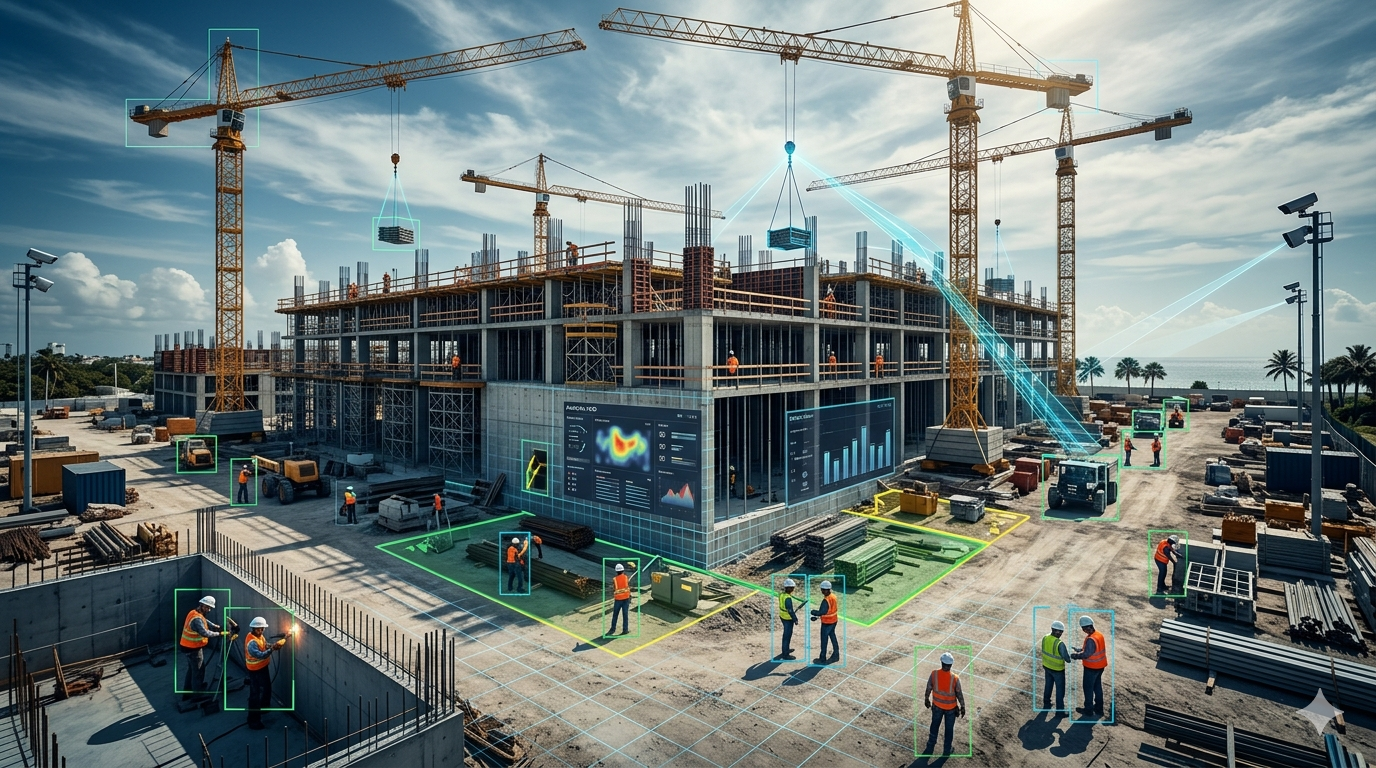
The current pipeline uses camera data, segmentation, tracking, depth estimation, and OSHA-oriented rules to turn a video segment into spatial findings. The goal is not just to detect objects, but to measure relationships between them in real units and present them in the units the client expects.
Existing video feeds
The system processes site camera footage and per-frame metadata. It can work with minimal calibration, then improves scale and projection quality when camera intrinsics, extrinsics, or known scene measurements are available.
Objects and masks
Neural models identify workers, PPE, equipment, ladders, barriers, zones, suspended loads, edges, and other safety objects. Tracks connect detections over time so duration, dwell time, and movement are measurable.
Measured 3D space
Masks are projected into camera-space and normal-aligned 3D views. The engine estimates distances, heights, boundaries, mutual positions, trajectories, speeds, and time-to-collision. Client-facing U.S. reports use feet, inches, mph, and OSHA-friendly thresholds.
Evidence output
Declarative JSON rules classify findings as compliant, non-compliant, not applicable, or insufficient evidence, then generate explanations, measurements, projection references, and evidence cards.
Project pre-assessment
Let us evaluate what can be detected on your site.
Send a sample video from one of your cameras, from 10 minutes to 24 hours long. We will review the footage and prepare a short assessment of which violation types can be detected reliably, which require zone setup, and what additional camera angles or labels would improve coverage.
How to submit
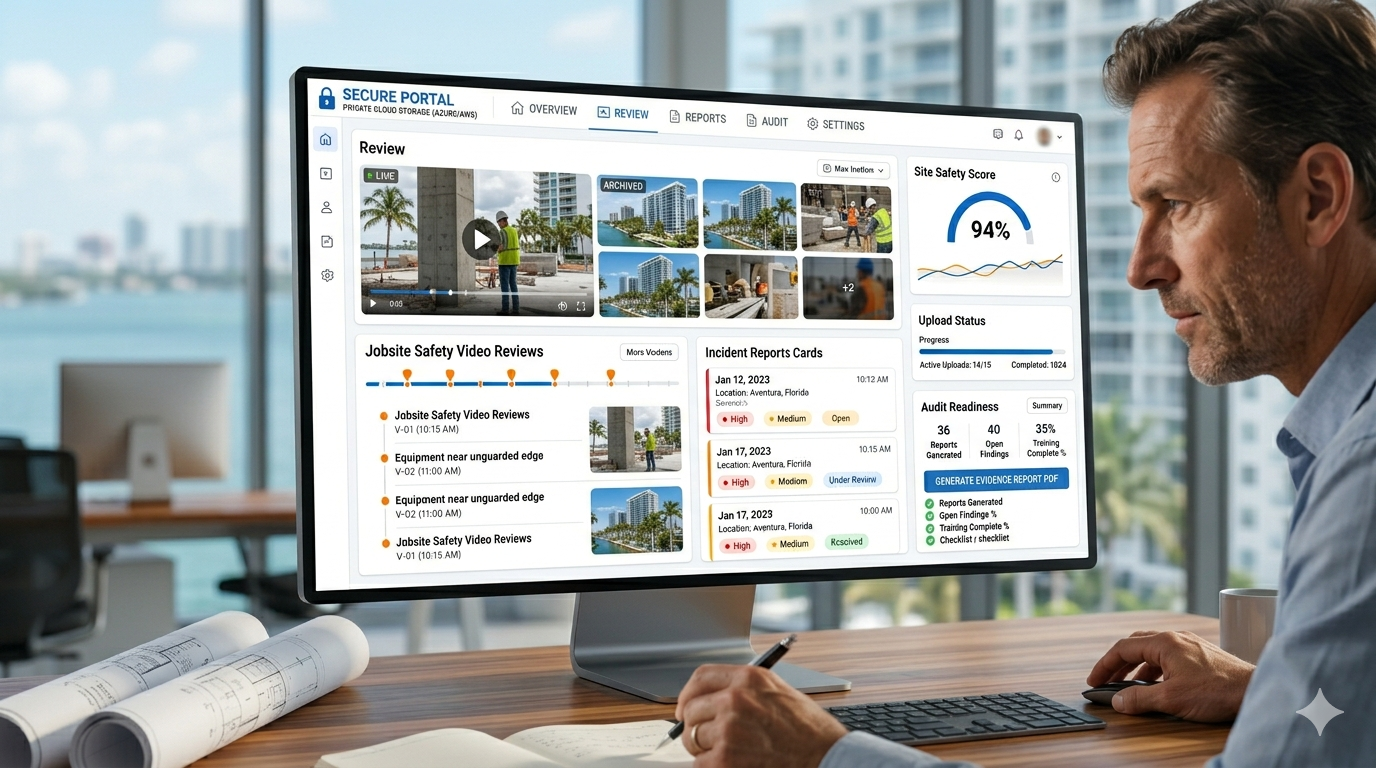
Use the secure upload link below or request a private transfer channel. Include the camera location, approximate work area, and any known site rules such as PPE policy, exclusion zones, traffic routes, or fall-protection zones.
Files upload directly to private S3 storage through a short-lived presigned URL; large videos do not pass through the website server.
Service calculator
Estimate the monitoring scope before we quote the project.
The fastest way to price the service is by camera coverage, review hours, reporting cadence, and site complexity. This calculator gives a planning range and creates a clean scope summary you can send with the contact form.
Client deliverable
Daily OSHA Compliance Report
The client receives a daily report with the most important violations, estimated penalty exposure, marked evidence moments, and concrete recommendations for every controlled rule family. This gives the safety officer detailed control over the jobsite at a scale that manual camera review cannot reach.
More reviewable safety moments than a human can reliably catch while also walking the site, answering calls, and documenting corrections.
Sample daily report
Harbor Point Mixed-Use Site
Example report for May 13, 2026. 11 cameras processed, 18 hours of footage reviewed, 214 annotated video moments generated.
Executive summary
The report separates one-off visual events from repeated patterns, so the client knows what to fix first and what to monitor after corrective action.
Workers outside defined walkways in active equipment areas.
Suspended-load and fall-protection exposures with critical severity.
PPE policy refresh, barricades, and lift-zone spotter enforcement.
Visual indicators
Daily indicators make the report readable in two minutes, while evidence links keep the details one click away.
Top findings with evidence and action plan
Each row links the violation to video evidence, OSHA context, estimated exposure, and the recommended correction.
| Finding | Evidence | Estimate | Recommended correction |
|---|---|---|---|
Suspended-load and lifting-zone exposure 9 events, 3 cameras, critical severity |
Open marked clip Includes projection, worker path, and load zone. |
$149,000-$330,000 | Stop lift operations when workers enter the load path, enforce exclusion zones, and require a visible spotter for active picks. |
Fall-risk work without visible harness/lanyard 6 events, critical severity |
Open evidence card Annotated worker, fall zone, and projection view. |
Up to $99,300 | Verify fall-protection plan, document anchor/lanyard use, and add camera-visible edge-zone controls before work resumes. |
Caught-between worker, equipment, and structure 5 events, critical severity |
Open marked clip Shows equipment movement and pinch corridor. |
Up to $82,750 | Add physical barricades, define no-go corridors, and update operator/ground-worker communication protocol. |
Walkway and vehicle-area zone violations 24 events, repeated pattern |
Open marked clip Shows walkway departure and missing separation. |
$16,550 per cited item | Repaint/mark walkways, add barrier separation near equipment, and brief subcontractors before shift start. |
Daily package
Critical issues, repeated patterns, and trend change since yesterday.
Rule ID, severity, time range, camera, object IDs, and measurements.
Annotated clips, frames, projection views, and downloadable evidence cards.
Recommended action, owner, priority, and follow-up status.
Recommendations by controlled area
Lifting and struck-by controls: enforce exclusion zones, require spotters, verify barrier placement, and review trajectory conflicts.
Fall protection: validate harness/lanyard visibility, guardrail condition, open-edge zones, and hoist-area protection.
PPE and pedestrian routes: confirm hard hats, high-visibility PPE, walkway discipline, and equipment-area separation.
Program management: track recurrence, measure closure rate, and use camera evidence to verify that corrective actions stayed fixed.
Operations, Security, And Camera Scale
OSHA Compliance AI is designed to review site footage continuously, without fatigue and without the attention drift that makes manual camera monitoring unreliable.
Secure processing
Video is processed on protected models inside our controlled environment. It is not published to the internet and is not sent to regulators. The purpose is private risk reduction before a fine, claim, or inspection.
How to provide video
Clients can provide access to live streams, transfer files physically, or enable automatic upload through our integration for near-real-time reports and 24/7 monitoring.
Hundreds of cameras
The system can review footage from many cameras in parallel. It does not get tired, skip quiet hours, or miss repeated low-frequency risks because nobody was watching that screen.
Single scene now, synchronized scenes next
Today, one video stream is treated as one camera scene for detection, tracking, and 3D measurement. Synchronizing several cameras is a realistic extension, not a blocker: overlapping cameras can be aligned by timestamps and calibration points, while non-overlapping cameras need cross-camera identity matching and site-map logic. The hardest part is reliable worker/equipment re-identification across blind spots, but the architecture can add it as a multi-camera layer above the current per-camera scene analysis.
Florida-based, built for Florida and Texas jobsite realities
We are a Florida-based company with an initial compliance focus on Florida and Texas contractors: federal OSHA coverage, fast-moving construction sites, heat exposure, traffic control, fall protection, PPE, and multi-subcontractor work zones. The product is not limited to those states; the rule catalog and reporting model can support U.S. contractors wherever federal OSHA or state-plan equivalents apply.
Construction Safety AI Solutions By Need
For contractors comparing OSHA compliance, jobsite video analytics, insurance risk controls, PPE monitoring, fall protection, and state-specific construction safety programs, these focused pages explain where OSHA Compliance AI fits.
Florida OSHA compliance monitoring
Federal OSHA coverage context, construction-camera review, daily reports, evidence clips, and risk reduction before inspections or claims.
Texas construction safety monitoring
OSHA-oriented AI review for fast-moving Texas jobsites with equipment traffic, heat exposure, PPE, lifting, and fall-risk work.
Construction safety video analytics
Turn existing cameras into worker tracking, PPE evidence, danger-zone monitoring, 3D measurements, and OSHA-oriented findings.
Use existing cameras for safety monitoring
Start from current CCTV, NVR footage, live streams, or secure uploads before investing in new camera infrastructure.
OSHA violation detection software
A focused overview of detected risk families: struck-by, caught-between, PPE, fall protection, ladders, scaffolds, and site zones.
PPE compliance monitoring
Hard hats, high-visibility PPE, harness/lanyard evidence, PPE fit concerns, and daily correction workflows.
Fall protection monitoring
Unprotected edges, fall-risk zones, hoist areas, scaffold guardrail evidence, and six-foot threshold reporting in U.S. units.
Construction insurance risk monitoring
Use private safety evidence to support risk reviews, subcontractor accountability, corrective action, and renewal conversations.
Daily OSHA safety reports
What the client receives: executive summary, evidence links, estimated exposure, recommendations, and follow-up tracking.
OSHA compliance video review by state
Florida and Texas priority coverage, with the same compliance-support workflow adaptable for contractors across U.S. states.
Miami OSHA compliance AI
AI video monitoring for South Florida construction safety, PPE, fall protection, equipment proximity, and daily reports.
Houston construction safety video analytics
OSHA-oriented camera review for Texas contractors managing lifts, equipment routes, heat exposure, and subcontractor risk.
OSHA AI video monitoring cost
How contractors should think about camera-hours, review cadence, setup, calibration, and pilot scope.
Detection Coverage: 25 Rule Catalog
These rules are a strong first compliance package for construction video. A full production program can add more site-specific checks by equipment type, zone policy, PPE policy, subcontractor workflow, environmental risk, and client SOP.
Core families
Struck-by, caught-between, zone control, PPE, PPE fit, fall protection, scaffolds, ladders, site access, and heat/rest/shade monitoring.
Deployment inputs
Rules use tracked workers and equipment, PPE evidence, 3D projections, camera-space measurements, ground/top views, and configured site zones where needed.
Compliance caution
The software produces compliance evidence and risk signals. Final legal classification remains the employer's and counsel's responsibility.
How many rules are enough?
There is no universal magic number. The current 25 cover the highest-value visual risks: struck-by, caught-between, PPE, fall protection, ladders, scaffolds, zones, site access, and heat/rest/shade. For a broad contractor rollout, a practical next target is 75-100 rules; for complex industrial or infrastructure sites, 120-150 rules is reasonable once site-specific zones, equipment classes, permit workflows, housekeeping, fire prevention, confined spaces, electrical clearances, and client SOPs are encoded. The advantage of the JSON rule catalog is that new checks can be configured without redesigning the whole pipeline.
| # | Rule ID | Detected violation / risk | Family | Severity | Deployment prequalification | OSHA basis | Key threshold |
|---|
OSHA And Florida Penalty Context
Florida does not operate a private-sector OSHA state plan, so private construction employers in Florida are generally covered by federal OSHA enforcement. Penalty amounts below follow OSHA's current published penalty table and should be rechecked before commercial use because OSHA adjusts maximum penalties periodically.
Maximum federal OSHA penalties
Current OSHA page lists maximums of $16,550 for serious, other-than-serious, and posting-requirement violations; $16,550 per day for failure to abate; and $165,514 for willful or repeated violations.
Primary legal and OSHA references
Use Cases And Evidence
These examples show the practical output: marked incident moments, evidence cards, source frames, and geometry diagnostics. Click any image or GIF to enlarge it and inspect the details.
FAQ
Practical answers for security, privacy, camera setup, and how teams use the reports.
Security and privacy
Is our footage shared with OSHA or regulators?
No. OSHA Compliance AI is designed for private preventive workflows. We do not automatically share customer footage, evidence, or reports with OSHA, the U.S. Department of Labor, or other regulators.
Are you affiliated with OSHA or the U.S. Department of Labor?
No. OSHA Compliance AI is an independent compliance-support product and is not affiliated with, endorsed by, sponsored by, or approved by OSHA or the U.S. Department of Labor.
Implementation
Can you use our existing cameras?
Usually, yes. We can start from ordinary site cameras with minimal setup. If you have camera details or known site measurements, we can improve accuracy for distance and zone-based rules.
How long should the sample video be?
A good starting sample is 10 minutes to 24 hours from one camera. Longer samples help capture more tasks, shifts, and hazard variety.
Do you offer live monitoring?
We support daily/weekly reporting and can also review near-real-time streams when needed. Most teams begin with a sample assessment and a reporting cadence, then expand to higher frequency for higher-risk zones.
Does this replace our safety officer?
No. The product supports safety teams by turning video into reviewable findings and corrective-action recommendations. It does not provide legal advice and is not a substitute for qualified safety leadership and site supervision.
More detail: Privacy Policy, Data Security, and OSHA affiliation disclaimer.
Contact us
Tell us about your site, number of cameras, and the safety issues you want to catch first. We can start with sample-file review, live streams, or an automated upload integration for ongoing 24/7 monitoring.