Florida-based OSHA compliance video intelligence
Active OSHA compliance from ordinary construction cameras.
OSHA Compliance AI converts passive site video into measurable safety evidence: object tracks, 3D spatial relations, rule-based OSHA findings, and audit-ready reports for management and compliance teams.
"You spend thousands of dollars on video surveillance systems that do not protect you from $160,000 OSHA fines. Why? Because no one watches this video."
OSHA Compliance AI is an independent compliance-support product and is not affiliated with, endorsed by, or sponsored by the U.S. Department of Labor or the Occupational Safety and Health Administration.
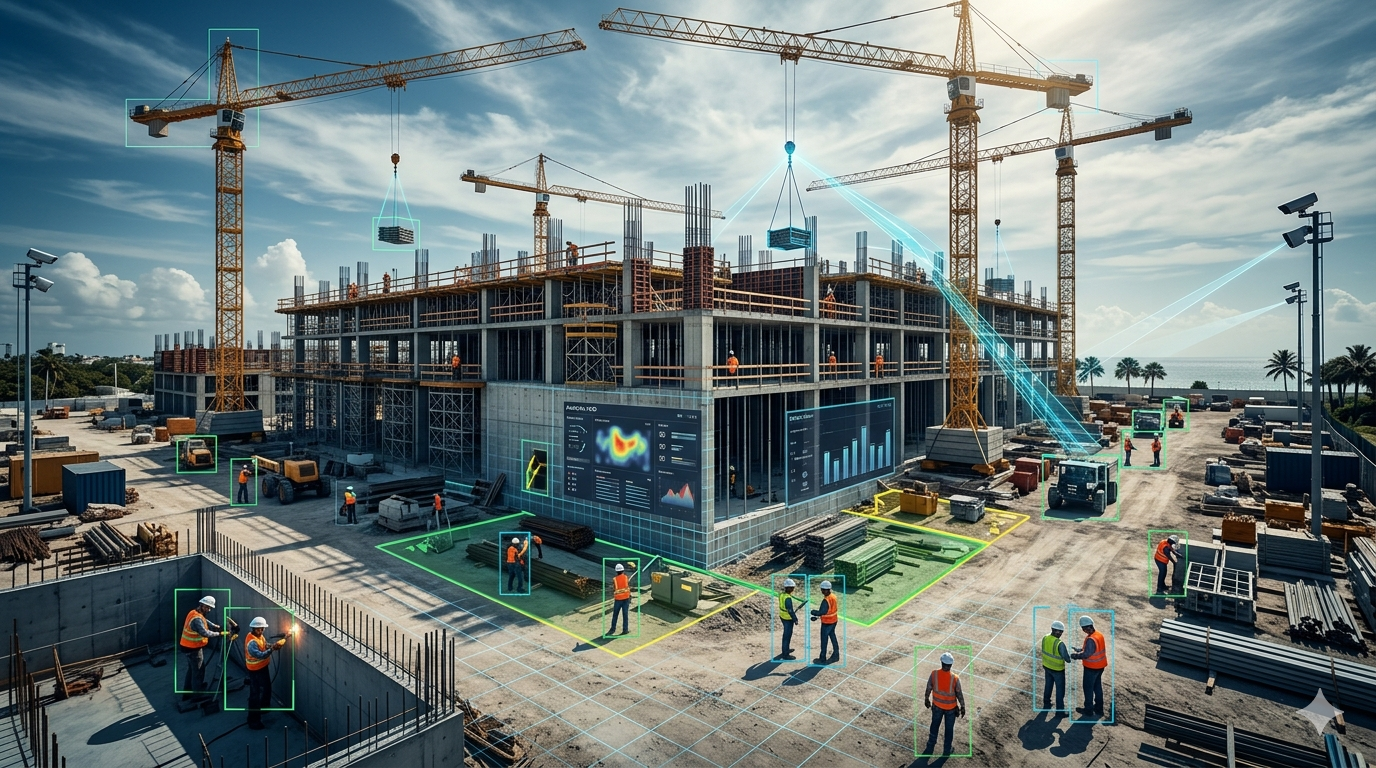
How The System Works
The current pipeline uses camera data, segmentation, tracking, depth estimation, and OSHA-oriented rules to turn a video segment into spatial findings. The goal is not just to detect objects, but to measure relationships between them in real units and present them in the units the client expects.
Existing video feeds
The system processes site camera footage and per-frame metadata. It can work with minimal calibration, then improves scale and projection quality when camera intrinsics, extrinsics, or known scene measurements are available.
Objects and masks
Neural models identify workers, PPE, equipment, ladders, barriers, zones, suspended loads, edges, and other safety objects. Tracks connect detections over time so duration, dwell time, and movement are measurable.
Measured 3D space
Masks are projected into camera-space and normal-aligned 3D views. The engine estimates distances, heights, boundaries, mutual positions, trajectories, speeds, and time-to-collision. Client-facing U.S. reports use feet, inches, mph, and OSHA-friendly thresholds.
Evidence output
Declarative JSON rules classify findings as compliant, non-compliant, not applicable, or insufficient evidence, then generate explanations, measurements, projection references, and evidence cards.
Project pre-assessment
Let us evaluate what can be detected on your site.
Send a sample video from one of your cameras, from 10 minutes to 24 hours long. We will review the footage and prepare a short assessment of which violation types can be detected reliably, which require zone setup, and what additional camera angles or labels would improve coverage.
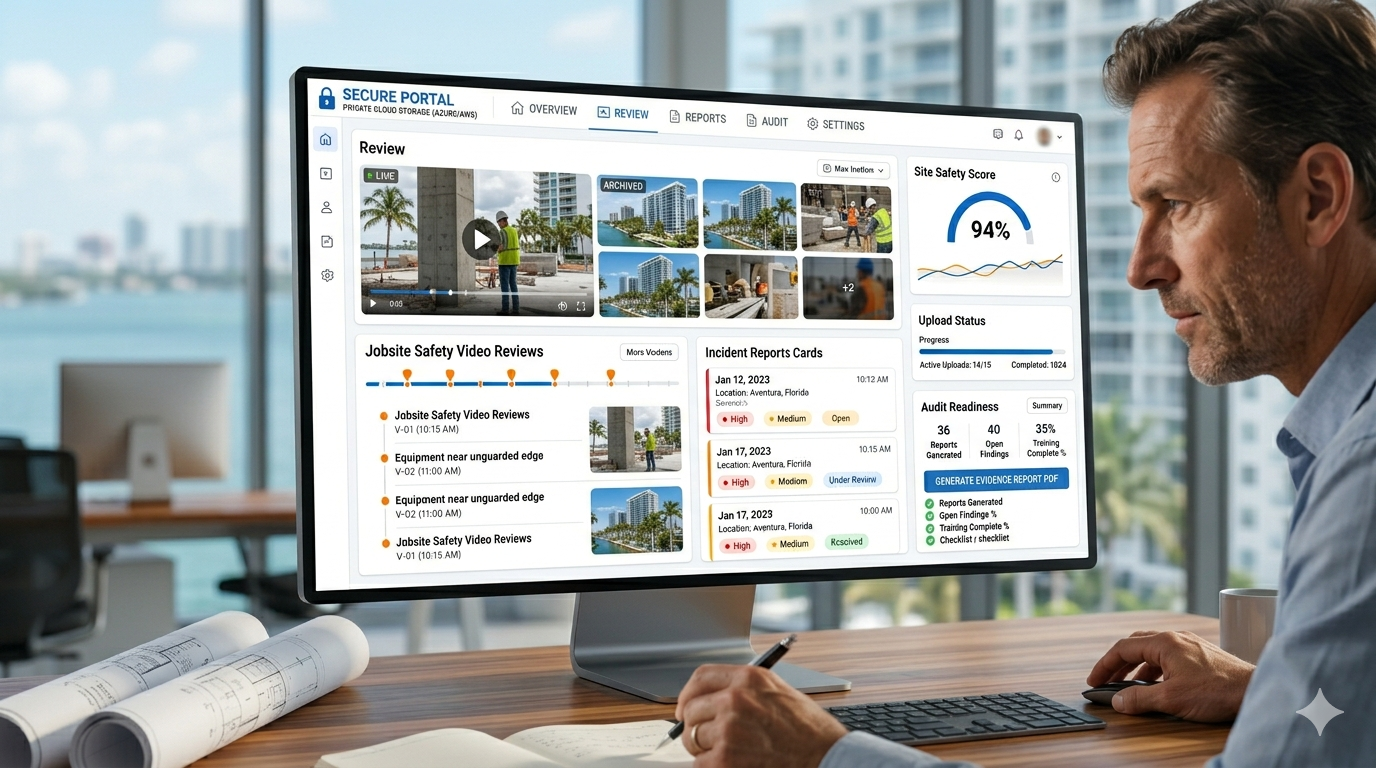
How to submit
Use the secure upload link below or request a private transfer channel. Include the camera location, approximate work area, and any known site rules such as PPE policy, exclusion zones, traffic routes, or fall-protection zones.
Files upload directly to private S3 storage through a short-lived presigned URL; large videos do not pass through the website server.
What The Client Receives
We watch the video and return an identified violation document plus marked video moments showing where, when, and why each issue happened.
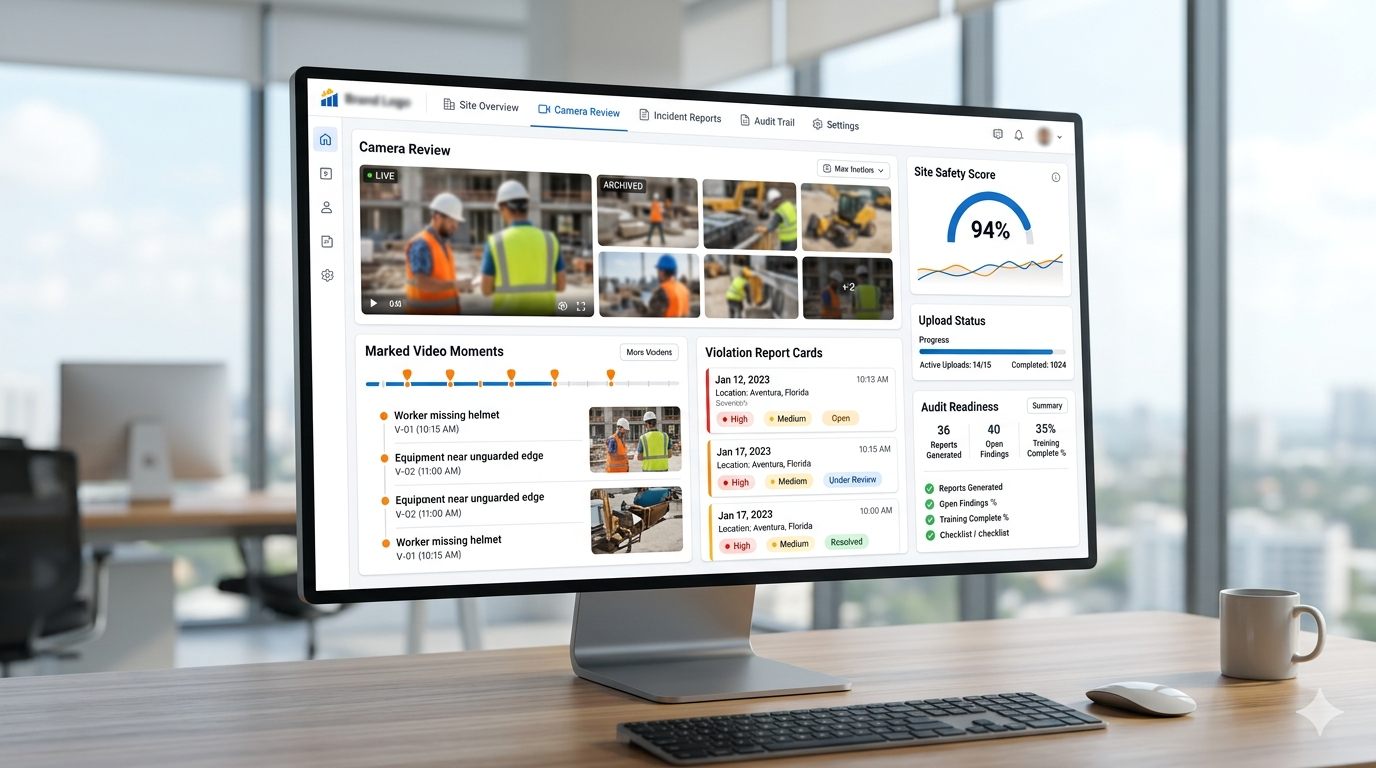
Violation document
A structured report with rule name, OSHA basis, severity, time range, object IDs, measurements, explanation, and recommended review priority.
Marked video evidence
Timestamped clips and frames with overlays: worker/equipment labels, danger zones, projected paths, distances, edge boundaries, and PPE association.
Management summary
Daily or weekly summaries for site managers: open violations, recurring patterns, camera coverage, risk trends, and corrective-action evidence.
Audit package
Evidence is kept between us and the client so teams can fix issues before an OSHA inspector or incident investigation turns them into penalties.
Operations, Security, And Camera Scale
OSHA Compliance AI is designed to review site footage continuously, without fatigue and without the attention drift that makes manual camera monitoring unreliable.
Secure processing
Video is processed on protected models inside our controlled environment. It is not published to the internet and is not sent to regulators. The purpose is private risk reduction before a fine, claim, or inspection.
How to provide video
Clients can provide access to live streams, transfer files physically, or enable automatic upload through our integration for near-real-time reports and 24/7 monitoring.
Hundreds of cameras
The system can review footage from many cameras in parallel. It does not get tired, skip quiet hours, or miss repeated low-frequency risks because nobody was watching that screen.
Single scene now, synchronized scenes next
Today, one video stream is treated as one camera scene for detection, tracking, and 3D measurement. Synchronizing several cameras is a realistic extension, not a blocker: overlapping cameras can be aligned by timestamps and calibration points, while non-overlapping cameras need cross-camera identity matching and site-map logic. The hardest part is reliable worker/equipment re-identification across blind spots, but the architecture can add it as a multi-camera layer above the current per-camera scene analysis.
Florida-based, built for Florida and Texas jobsite realities
We are a Florida-based company with an initial compliance focus on Florida and Texas contractors: federal OSHA coverage, fast-moving construction sites, heat exposure, traffic control, fall protection, PPE, and multi-subcontractor work zones. The product is not limited to those states; the rule catalog and reporting model can support U.S. contractors wherever federal OSHA or state-plan equivalents apply.
Detection Coverage: 25 Rule Catalog
These rules are a strong first compliance package for construction video. A full production program can add more site-specific checks by equipment type, zone policy, PPE policy, subcontractor workflow, environmental risk, and client SOP.
Core families
Struck-by, caught-between, zone control, PPE, PPE fit, fall protection, scaffolds, ladders, site access, and heat/rest/shade monitoring.
Current engine contract
Rules consume tracked 2D SAM objects, normal-aligned 3D masks, object tracks, camera reprojection, ground/top projections, and configured zones where needed.
Compliance caution
The software produces compliance evidence and risk signals. Final legal classification remains the employer's and counsel's responsibility.
How many rules are enough?
There is no universal magic number. The current 25 cover the highest-value visual risks: struck-by, caught-between, PPE, fall protection, ladders, scaffolds, zones, site access, and heat/rest/shade. For a broad contractor rollout, a practical next target is 75-100 rules; for complex industrial or infrastructure sites, 120-150 rules is reasonable once site-specific zones, equipment classes, permit workflows, housekeeping, fire prevention, confined spaces, electrical clearances, and client SOPs are encoded. The advantage of the JSON rule catalog is that new checks can be configured without redesigning the whole pipeline.
| # | Rule ID | Detected violation / risk | Family | Severity | Deployment prequalification | OSHA basis | Key threshold |
|---|
OSHA And Florida Penalty Context
Florida does not operate a private-sector OSHA state plan, so private construction employers in Florida are generally covered by federal OSHA enforcement. Penalty amounts below follow OSHA's current published penalty table and should be rechecked before commercial use because OSHA adjusts maximum penalties periodically.
Maximum federal OSHA penalties
Current OSHA page lists maximums of $16,550 for serious, other-than-serious, and posting-requirement violations; $16,550 per day for failure to abate; and $165,514 for willful or repeated violations.
Primary legal and OSHA references
Evidence Image Placeholders
Place final screenshots, GIFs, or short video previews in site/assets/media with these filenames. The page already points to them, so examples will appear automatically when files are added.
Contact us
Tell us about your site, number of cameras, and the safety issues you want to catch first. We can start with sample-file review, live streams, or an automated upload integration for ongoing 24/7 monitoring.