Fall protection
Fall protection monitoring for construction video
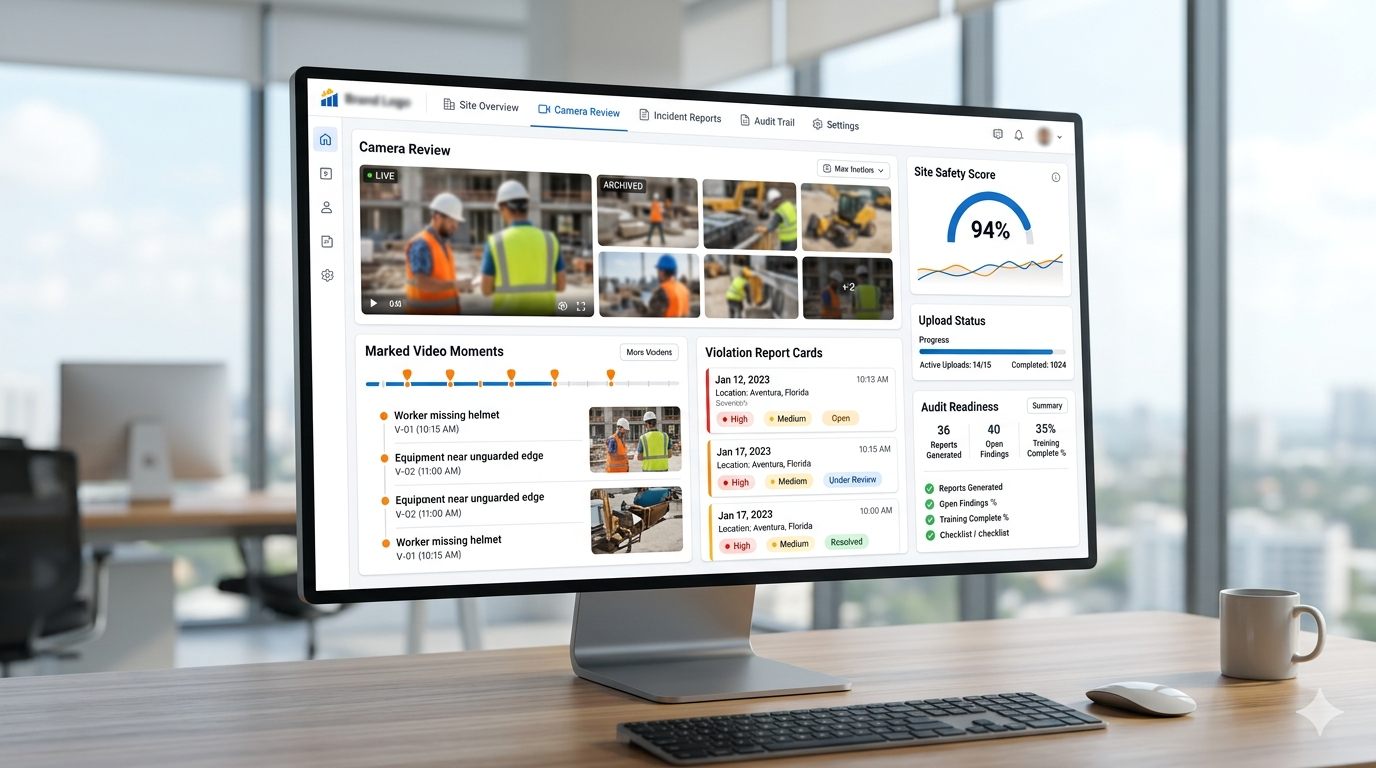
Falls remain one of the highest-value construction safety risks to detect early. OSHA Compliance AI reviews camera footage for visible fall-risk situations and packages evidence for safety teams.
Open edges and fall-risk zones
The system can evaluate worker position relative to configured fall zones, hoist/loading areas, scaffold edges, floor holes, and other edge conditions that are visible in video.
Harness and guardrail evidence
When workers appear near fall zones, the report checks for visible harness/lanyard evidence and guardrail conditions where the camera angle supports it.
Daily prioritization
Fall-risk findings are surfaced as critical issues with evidence links, time ranges, measurements, and corrective-action recommendations.
What this page covers
- Worker near unprotected open edge
- Worker in fall-risk zone without visible harness/lanyard
- Hoist/loading edge area without protection
- Scaffold platform without visible guardrail
Frequently asked questions
Short answers for contractors, safety officers, and risk teams evaluating AI video review for compliance support.
Can the system measure six-foot fall thresholds?
Reports use client-facing feet and inches. Reliable fall-height and edge distance analysis improves when camera calibration or known site measurements are available.
Can it detect every fall hazard?
No camera system sees everything. It prioritizes visible risks and marks insufficient evidence when the view is not enough.
Why use video for fall protection?
Video creates time-stamped evidence that can be reviewed, corrected, and tracked across shifts instead of relying only on periodic walkthroughs.
Related OSHA Compliance AI pages
AI video review for Florida construction contractors: OSHA compliance reports, PPE and fall-protection monitoring, violation evidence, and penalty exposure estimates.
AI construction safety monitoring for Texas contractors: OSHA-oriented video review, violation detection, evidence clips, daily reports, and corrective-action recommendations.
Turn construction cameras into safety analytics: worker tracking, PPE checks, danger zones, 3D distance estimates, OSHA-oriented reports, and evidence clips.
OSHA-oriented violation detection from jobsite video: PPE, fall protection, struck-by risk, caught-between risk, exclusion zones, ladders, and scaffolds.
AI PPE compliance monitoring for construction: hard hat detection, high-visibility vest checks, fall-risk PPE evidence, and daily safety reports.
AI construction risk monitoring for contractors and insurance teams: OSHA-oriented safety evidence, recurring hazard trends, and daily jobsite risk reports.
Daily OSHA-oriented construction safety reports with top violations, evidence clips, severity, penalty exposure estimates, and corrective-action recommendations.
Daily OSHA-oriented safety reports for general contractors: cross-sub coordination, PPE and fall protection evidence, high-severity risk tracking, and corrective-action follow-up.
Safety evidence and daily OSHA-oriented reporting for subcontractors: PPE, fall-risk work, equipment proximity, and corrective-action recommendations from existing cameras.
Expand your safety consulting impact with OSHA-oriented video evidence: daily findings, marked clips, recurring hazard trends, and corrective-action recommendations.
Construction safety evidence for insurance and risk teams: recurring hazard trends, high-severity exposures, and corrective-action follow-up from ordinary jobsite cameras.
Owner/developer safety oversight with evidence: daily summaries, high-severity hazard visibility, and corrective-action follow-up from jobsite cameras.