Florida construction safety
Florida OSHA compliance monitoring from construction cameras
Florida private-sector construction employers are generally covered by federal OSHA enforcement. OSHA Compliance AI helps safety teams review ordinary jobsite camera footage for visible risks before an inspector, incident, or claim turns them into expensive findings.
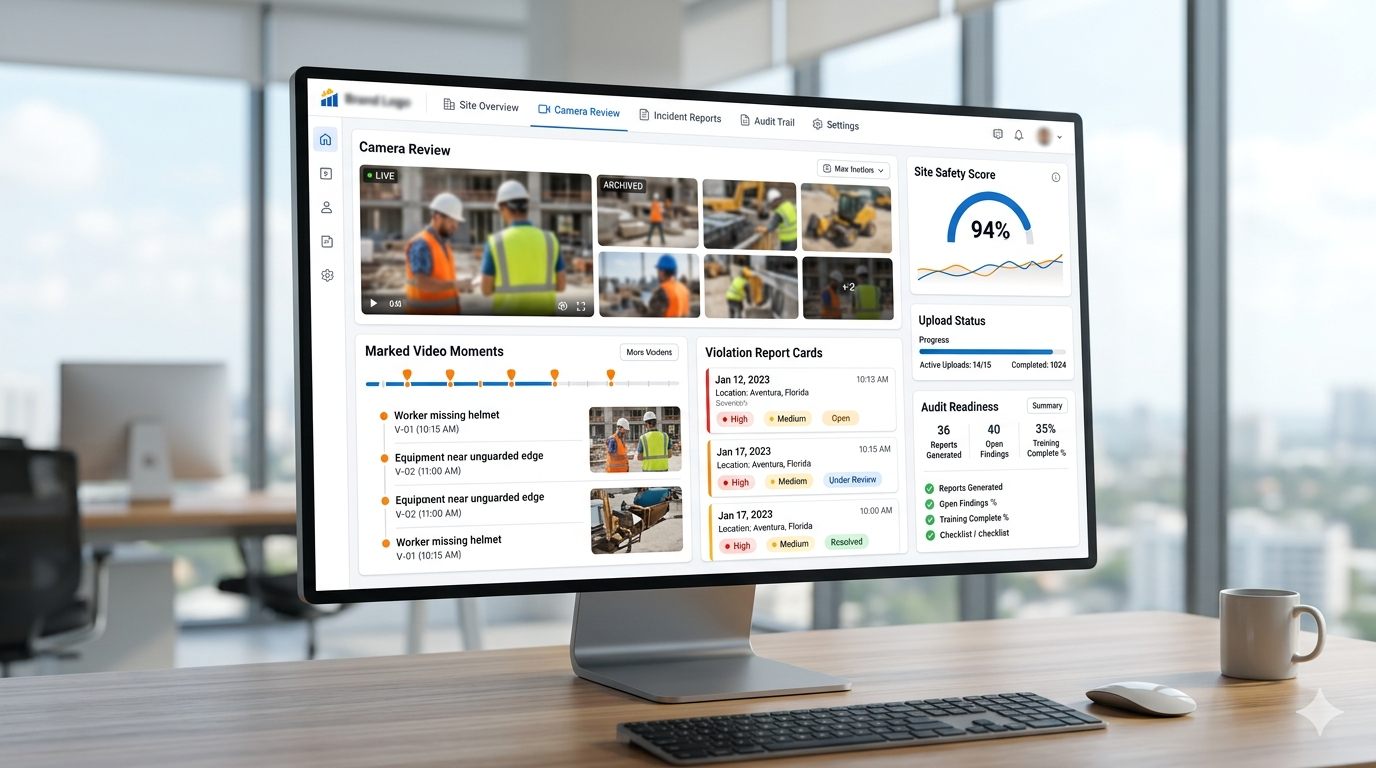
Why Florida teams use it
Florida jobsites combine heat exposure, fast equipment movement, storm-driven schedule pressure, multi-subcontractor work, and tight staging areas. A camera system is already watching most of this, but the footage is rarely reviewed in time. The report turns passive video into a daily safety control.
Florida-specific risk patterns
The first rule catalog focuses on high-value visual risks: hard-hat and high-visibility PPE, fall-zone exposure, unprotected edges, worker/equipment proximity, suspended-load exposure, walkway discipline, missing barriers, ladders, scaffolds, and heat/rest/shade signals.
What the client receives
Each daily report includes top violations, evidence clips, source frames, camera-space measurements, estimated penalty exposure, and recommended corrections. The goal is private prevention, not public enforcement.
What this page covers
- Federal OSHA context for private-sector Florida construction
- Daily safety reports for project managers and safety officers
- Evidence links for lift zones, fall protection, PPE, and traffic control
- Secure review before fines, claims, or inspections
Frequently asked questions
Short answers for contractors, safety officers, and risk teams evaluating AI video review for compliance support.
Does this replace a Florida safety officer?
No. It gives the safety officer much broader visibility. The system reviews more camera footage than a person can watch manually and packages the evidence for review.
Can it work with existing Florida jobsite cameras?
Yes. It is designed to start from existing video feeds or uploaded footage, then improve with camera calibration and site-zone configuration.
Is this connected to OSHA?
No. OSHA Compliance AI is independent compliance-support software and is not affiliated with or endorsed by OSHA or the U.S. Department of Labor.
Related OSHA Compliance AI pages
AI construction safety monitoring for Texas contractors: OSHA-oriented video review, violation detection, evidence clips, daily reports, and corrective-action recommendations.
Turn construction cameras into safety analytics: worker tracking, PPE checks, danger zones, 3D distance estimates, OSHA-oriented reports, and evidence clips.
OSHA-oriented violation detection from jobsite video: PPE, fall protection, struck-by risk, caught-between risk, exclusion zones, ladders, and scaffolds.
AI PPE compliance monitoring for construction: hard hat detection, high-visibility vest checks, fall-risk PPE evidence, and daily safety reports.
AI fall protection monitoring for construction cameras: unprotected edges, fall-risk zones, missing harness/lanyard evidence, scaffolds, and daily OSHA-oriented reports.
AI construction risk monitoring for contractors and insurance teams: OSHA-oriented safety evidence, recurring hazard trends, and daily jobsite risk reports.
Daily OSHA-oriented construction safety reports with top violations, evidence clips, severity, penalty exposure estimates, and corrective-action recommendations.
Daily OSHA-oriented safety reports for general contractors: cross-sub coordination, PPE and fall protection evidence, high-severity risk tracking, and corrective-action follow-up.
Safety evidence and daily OSHA-oriented reporting for subcontractors: PPE, fall-risk work, equipment proximity, and corrective-action recommendations from existing cameras.
Expand your safety consulting impact with OSHA-oriented video evidence: daily findings, marked clips, recurring hazard trends, and corrective-action recommendations.
Construction safety evidence for insurance and risk teams: recurring hazard trends, high-severity exposures, and corrective-action follow-up from ordinary jobsite cameras.
Owner/developer safety oversight with evidence: daily summaries, high-severity hazard visibility, and corrective-action follow-up from jobsite cameras.