Implementation guide
How to use construction cameras for OSHA compliance monitoring
A security camera records what happened. A compliance monitoring workflow reviews the footage, detects risk patterns, and turns the evidence into actions a safety team can use the next morning.
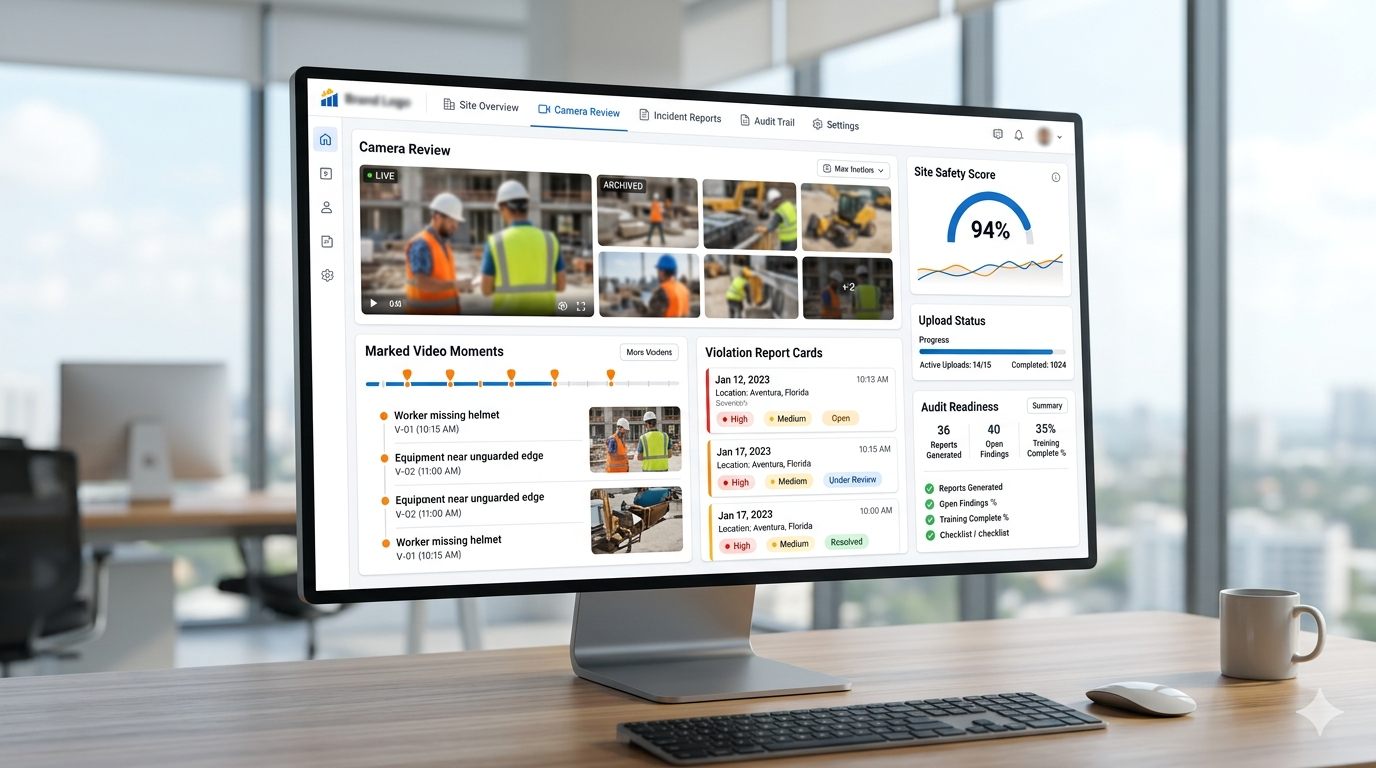
Start with camera coverage
Inventory cameras by work area, resolution, night visibility, angle, and whether they see people, equipment, edges, ladders, scaffolds, walkways, and lift zones.
Add site rules
The strongest results come when footage is paired with PPE policy, traffic routes, restricted zones, fall-protection zones, water/rest/shade locations, and known work schedules.
Turn findings into action
Daily reports should include evidence links, severity, estimated exposure, recommended corrections, recurrence, and follow-up status so the safety officer can close the loop.
What this page covers
- Camera inventory and coverage plan
- Zone setup for traffic, fall protection, and lifts
- Daily report workflow
- Evidence review and corrective action
Frequently asked questions
Short answers for contractors, safety officers, and risk teams evaluating AI video review for compliance support.
Do we need perfect camera calibration?
No. The workflow can start with limited calibration and improve as known dimensions, zones, and camera metadata become available.
What footage should we send first?
Send 10 minutes to 24 hours from a camera that sees active work, equipment movement, PPE behavior, or elevated work.
Can this work with NVR exports?
Yes. Uploaded files, archive exports, live streams, and automated uploads are all usable intake paths.
Related OSHA Compliance AI pages
AI video review for Florida construction contractors: OSHA compliance reports, PPE and fall-protection monitoring, violation evidence, and penalty exposure estimates.
AI construction safety monitoring for Texas contractors: OSHA-oriented video review, violation detection, evidence clips, daily reports, and corrective-action recommendations.
Turn construction cameras into safety analytics: worker tracking, PPE checks, danger zones, 3D distance estimates, OSHA-oriented reports, and evidence clips.
OSHA-oriented violation detection from jobsite video: PPE, fall protection, struck-by risk, caught-between risk, exclusion zones, ladders, and scaffolds.
AI PPE compliance monitoring for construction: hard hat detection, high-visibility vest checks, fall-risk PPE evidence, and daily safety reports.
AI fall protection monitoring for construction cameras: unprotected edges, fall-risk zones, missing harness/lanyard evidence, scaffolds, and daily OSHA-oriented reports.
AI construction risk monitoring for contractors and insurance teams: OSHA-oriented safety evidence, recurring hazard trends, and daily jobsite risk reports.
Daily OSHA-oriented construction safety reports with top violations, evidence clips, severity, penalty exposure estimates, and corrective-action recommendations.
Daily OSHA-oriented safety reports for general contractors: cross-sub coordination, PPE and fall protection evidence, high-severity risk tracking, and corrective-action follow-up.
Safety evidence and daily OSHA-oriented reporting for subcontractors: PPE, fall-risk work, equipment proximity, and corrective-action recommendations from existing cameras.
Expand your safety consulting impact with OSHA-oriented video evidence: daily findings, marked clips, recurring hazard trends, and corrective-action recommendations.
Construction safety evidence for insurance and risk teams: recurring hazard trends, high-severity exposures, and corrective-action follow-up from ordinary jobsite cameras.