Reporting guide
Daily OSHA safety report: what to include and how teams use it
A daily report is only useful if it creates action the next morning. The best format is short, evidence-backed, and designed for supervisors: what happened, why it matters, and what to do next.
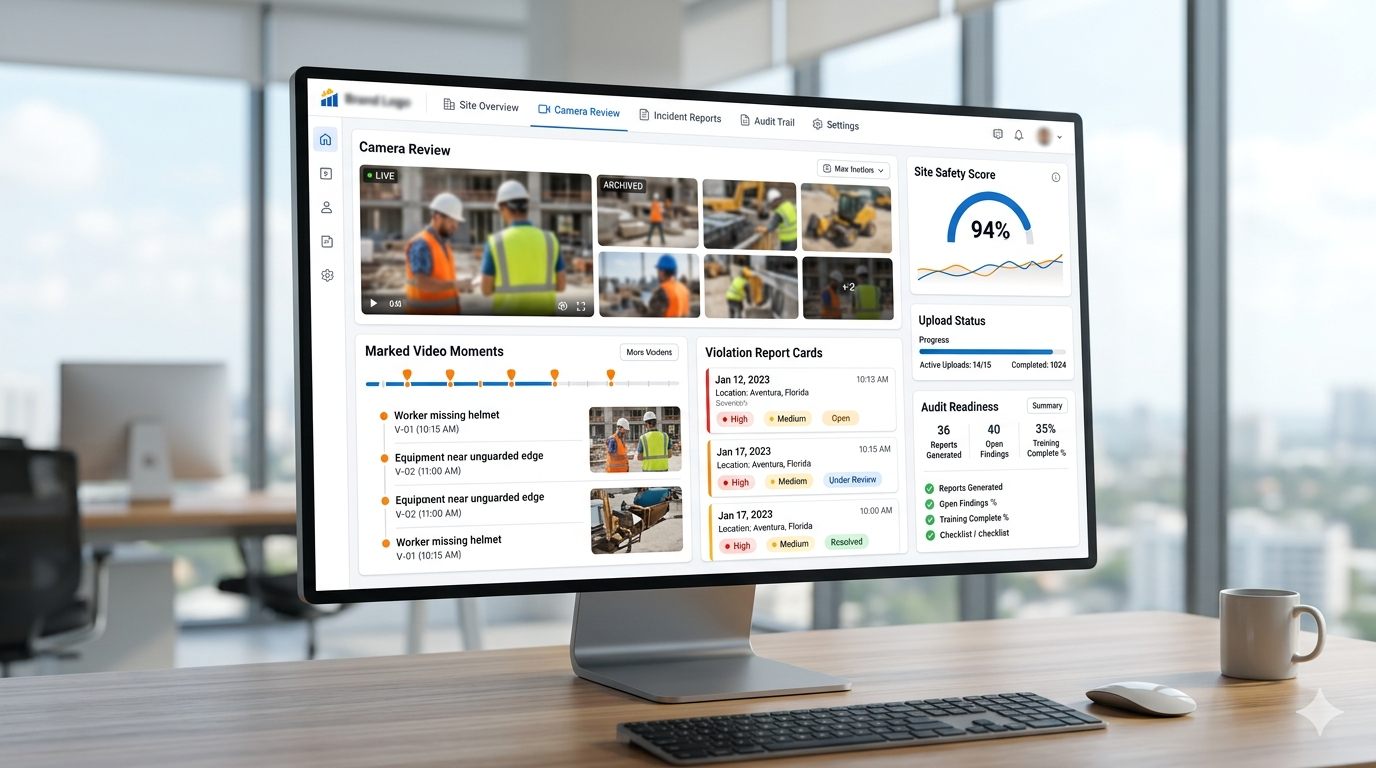
Executive summary first
Start with 3–7 sentences: high-severity exposures, what repeated, and what changed after previous corrective actions.
Finding rows with evidence links
Each row should include hazard family, time range, camera, a marked clip or frame, short explanation, and a recommended correction.
Exposure and prioritization
Severity and exposure duration help prioritize. Where measurement is feasible, include simple thresholds in U.S. units (feet/inches) so teams can act fast.
Close the loop with follow-up
Track whether corrective actions were assigned, completed, and whether recurrence dropped over the next days.
What this page covers
- Short executive summary for leadership
- Evidence links for supervisors
- Prioritized recommendations (next actions)
- Recurrence + follow-up tracking
Frequently asked questions
Short answers for contractors, safety officers, and risk teams evaluating AI video review for compliance support.
Is a daily report a substitute for a safety officer?
No. It supports safety leadership by scaling visibility and packaging evidence, but it does not replace supervision or provide legal advice.
Can reports be generated from existing cameras?
Usually, yes. Teams can start from existing footage and improve accuracy with calibration and zone setup.
Does the report automatically mean an OSHA violation occurred?
No. The report surfaces likely risk patterns and evidence for review; compliance decisions remain with the employer and counsel.
Related OSHA Compliance AI pages
AI video review for Florida construction contractors: OSHA compliance reports, PPE and fall-protection monitoring, violation evidence, and penalty exposure estimates.
AI construction safety monitoring for Texas contractors: OSHA-oriented video review, violation detection, evidence clips, daily reports, and corrective-action recommendations.
Turn construction cameras into safety analytics: worker tracking, PPE checks, danger zones, 3D distance estimates, OSHA-oriented reports, and evidence clips.
OSHA-oriented violation detection from jobsite video: PPE, fall protection, struck-by risk, caught-between risk, exclusion zones, ladders, and scaffolds.
AI PPE compliance monitoring for construction: hard hat detection, high-visibility vest checks, fall-risk PPE evidence, and daily safety reports.
AI fall protection monitoring for construction cameras: unprotected edges, fall-risk zones, missing harness/lanyard evidence, scaffolds, and daily OSHA-oriented reports.
AI construction risk monitoring for contractors and insurance teams: OSHA-oriented safety evidence, recurring hazard trends, and daily jobsite risk reports.
Daily OSHA-oriented construction safety reports with top violations, evidence clips, severity, penalty exposure estimates, and corrective-action recommendations.
Daily OSHA-oriented safety reports for general contractors: cross-sub coordination, PPE and fall protection evidence, high-severity risk tracking, and corrective-action follow-up.
Safety evidence and daily OSHA-oriented reporting for subcontractors: PPE, fall-risk work, equipment proximity, and corrective-action recommendations from existing cameras.
Expand your safety consulting impact with OSHA-oriented video evidence: daily findings, marked clips, recurring hazard trends, and corrective-action recommendations.
Construction safety evidence for insurance and risk teams: recurring hazard trends, high-severity exposures, and corrective-action follow-up from ordinary jobsite cameras.