Prevention guide
Security cameras vs OSHA prevention: recording isn’t compliance
Many contractors already have cameras, but most footage is never reviewed until after something happens. OSHA prevention is a workflow: review, detect patterns, assign corrections, and verify that controls remain in place.
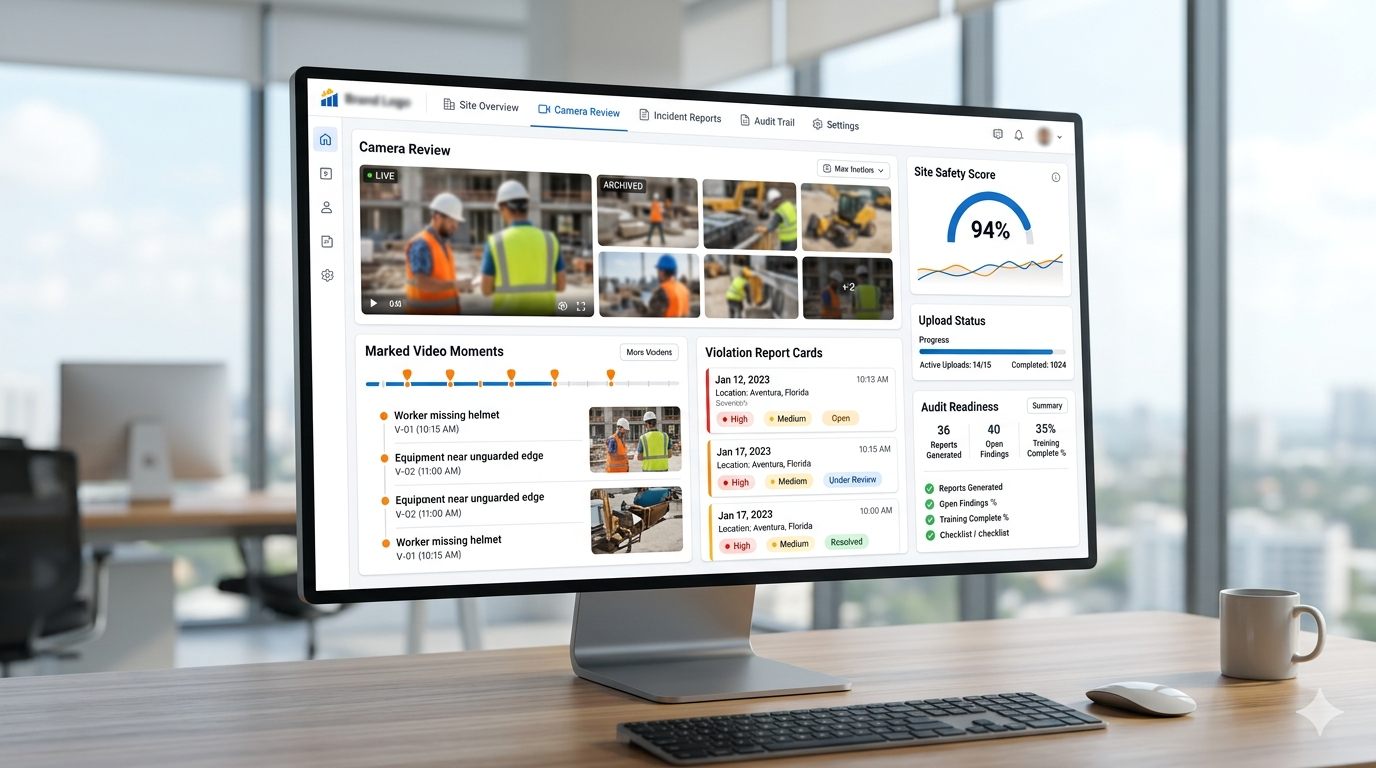
What cameras do well
Cameras provide coverage and a historical record. They are useful when a supervisor can quickly find the right moment and understand what happened.
What cameras do not do by default
Cameras do not measure proximity, duration, or zone entry; they do not map events to hazard families; and they do not produce corrective-action recommendations or recurrence tracking.
What an OSHA-oriented review adds
An OSHA-oriented review workflow outputs marked clips, evidence links, measurements (when possible), and a daily report that prioritizes corrective actions for the safety officer and superintendent.
How to start without ripping anything out
Start with a sample upload or NVR export from the cameras that see equipment routes, elevated work, lift zones, walkways, and PPE-heavy areas.
What this page covers
- Recording ≠ risk detection
- Context: zones, routes, fall edges, lift areas
- Outputs: evidence links + report rows
- Follow-up: recurrence and corrective action
Frequently asked questions
Short answers for contractors, safety officers, and risk teams evaluating AI video review for compliance support.
Do you need to replace the camera system?
Not necessarily. The workflow is designed to start from existing cameras and improve results with calibration points and site-zone configuration.
Is this the same as security alerts?
No. Security alerts focus on intrusion or motion. OSHA-oriented review focuses on safety context, hazard families, and corrective-action workflows.
Can this be used privately without sharing to regulators?
Yes. The default workflow is private to the customer; footage and reports are not shared with regulators by default.
Related OSHA Compliance AI pages
AI video review for Florida construction contractors: OSHA compliance reports, PPE and fall-protection monitoring, violation evidence, and penalty exposure estimates.
AI construction safety monitoring for Texas contractors: OSHA-oriented video review, violation detection, evidence clips, daily reports, and corrective-action recommendations.
Turn construction cameras into safety analytics: worker tracking, PPE checks, danger zones, 3D distance estimates, OSHA-oriented reports, and evidence clips.
OSHA-oriented violation detection from jobsite video: PPE, fall protection, struck-by risk, caught-between risk, exclusion zones, ladders, and scaffolds.
AI PPE compliance monitoring for construction: hard hat detection, high-visibility vest checks, fall-risk PPE evidence, and daily safety reports.
AI fall protection monitoring for construction cameras: unprotected edges, fall-risk zones, missing harness/lanyard evidence, scaffolds, and daily OSHA-oriented reports.
AI construction risk monitoring for contractors and insurance teams: OSHA-oriented safety evidence, recurring hazard trends, and daily jobsite risk reports.
Daily OSHA-oriented construction safety reports with top violations, evidence clips, severity, penalty exposure estimates, and corrective-action recommendations.
Daily OSHA-oriented safety reports for general contractors: cross-sub coordination, PPE and fall protection evidence, high-severity risk tracking, and corrective-action follow-up.
Safety evidence and daily OSHA-oriented reporting for subcontractors: PPE, fall-risk work, equipment proximity, and corrective-action recommendations from existing cameras.
Expand your safety consulting impact with OSHA-oriented video evidence: daily findings, marked clips, recurring hazard trends, and corrective-action recommendations.
Construction safety evidence for insurance and risk teams: recurring hazard trends, high-severity exposures, and corrective-action follow-up from ordinary jobsite cameras.