Sample report
Sample OSHA safety report (illustrative)
This page shows a realistic report layout: a short executive summary, a table of top findings with evidence links, an illustrative penalty exposure estimate, and prioritized corrective-action recommendations.
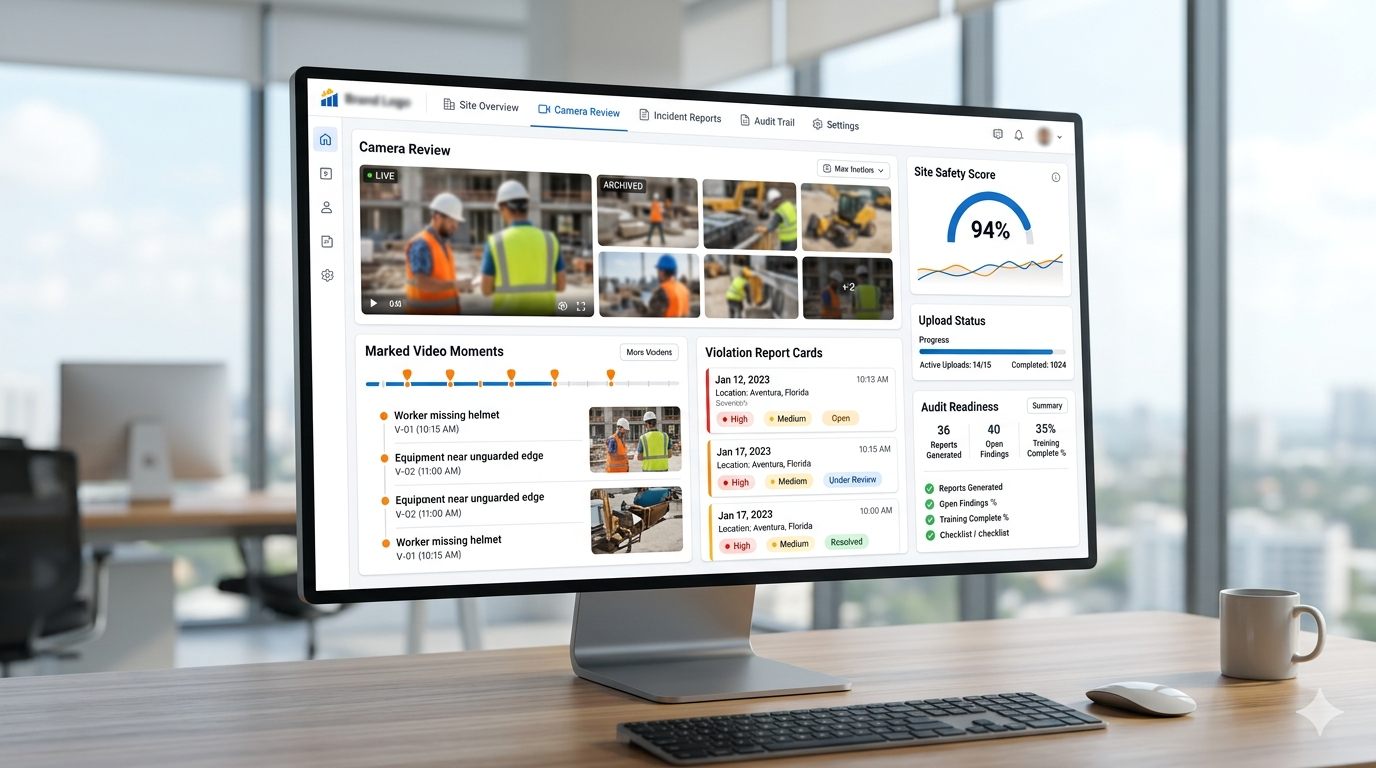
What you get
An executive summary for leadership, a prioritized finding list with evidence links, and corrective-action recommendations you can assign and verify.
Designed for private prevention
Findings and evidence are meant for internal correction workflows. Customer footage and reports are not shared with regulators by default.
Executive summary
Top findings (with evidence links)
Each row links to example evidence frames. In real reports, links point to time-ranged clips, annotated frames, and measurements.
| Severity | Finding | Illustrative max penalty | Recommendation |
|---|---|---|---|
| High |
Worker near open edge without visible fall protection
Level 3 slab edge (east) · 09:14–09:16
|
$16,550 | Stop work in edge zone; install guardrail or PFAS; document correction with photo/video. |
| Medium |
Missing hard hat in active equipment-adjacent zone
Loading lane / telehandler route · 10:02–10:04
|
$8,275 | Coach crew; enforce PPE signage at gate; add spot checks in shift start workflow. |
| Medium |
Work under suspended load (lift zone intrusion)
Hoist / pick zone · 13:41–13:42
|
$8,275 | Re-establish exclusion zone; assign lift director; enforce barricades and radio calls. |
Penalty values shown are illustrative maximums and can change; recheck current OSHA penalty tables before commercial use.
Penalty exposure estimate (illustrative)
The report summarizes a conservative “maximum exposure” estimate based on the severity mix. Teams use this to prioritize corrections and communicate risk.
Recommendations (corrective-action plan)
- Immediate controls: barricade edges and lift zones; stop work inside exclusion areas until controls are restored.
- PPE enforcement: gate check + toolbox talk; document repeated noncompliance by crew/area.
- Verification: capture a follow-up clip/photo after corrective action; track recurrence by camera and zone.
- Weekly trend review: review top recurring patterns; update site zones and workflows to eliminate repeat causes.
Related OSHA Compliance AI pages
AI video review for Florida construction contractors: OSHA compliance reports, PPE and fall-protection monitoring, violation evidence, and penalty exposure estimates.
AI construction safety monitoring for Texas contractors: OSHA-oriented video review, violation detection, evidence clips, daily reports, and corrective-action recommendations.
Turn construction cameras into safety analytics: worker tracking, PPE checks, danger zones, 3D distance estimates, OSHA-oriented reports, and evidence clips.
OSHA-oriented violation detection from jobsite video: PPE, fall protection, struck-by risk, caught-between risk, exclusion zones, ladders, and scaffolds.
AI PPE compliance monitoring for construction: hard hat detection, high-visibility vest checks, fall-risk PPE evidence, and daily safety reports.
AI fall protection monitoring for construction cameras: unprotected edges, fall-risk zones, missing harness/lanyard evidence, scaffolds, and daily OSHA-oriented reports.
AI construction risk monitoring for contractors and insurance teams: OSHA-oriented safety evidence, recurring hazard trends, and daily jobsite risk reports.
Daily OSHA-oriented construction safety reports with top violations, evidence clips, severity, penalty exposure estimates, and corrective-action recommendations.
Daily OSHA-oriented safety reports for general contractors: cross-sub coordination, PPE and fall protection evidence, high-severity risk tracking, and corrective-action follow-up.
Safety evidence and daily OSHA-oriented reporting for subcontractors: PPE, fall-risk work, equipment proximity, and corrective-action recommendations from existing cameras.
Expand your safety consulting impact with OSHA-oriented video evidence: daily findings, marked clips, recurring hazard trends, and corrective-action recommendations.
Construction safety evidence for insurance and risk teams: recurring hazard trends, high-severity exposures, and corrective-action follow-up from ordinary jobsite cameras.